Skip to content
Smart AC Solutions
  • CategoriesExpand
    • AC Troubleshooting
    • Air ConditionerExpand
      • Portable Air Conditioners
      • Room Air Conditioners
      • Split System Air Conditioners
      • Window Air Conditioners
      • Reviews & Prices
    • Thermostat Solutions
    • Calculator
  • Directory
  • Request HVAC Service
  • Join Our Pro NetworkExpand
    • HVAC BusinessesExpand
      • Residential
      • Commercial
      • Emergency Services
    • Add Business
  • Register
  • Login
  • Forgot Password?
Smart AC Solutions
Air Conditioner

Don’t Use WD-40 on AC Units—Use AC-Specific Oils

ByRalph P. Sita Updated onJune 29, 2026


No, you should not use WD-40 on air conditioning systems. WD-40 is a general-purpose penetrating oil designed for rust removal and light lubrication, but it contains solvents and additives that are incompatible with AC refrigerants and compressor oils. Using WD-40 can contaminate your refrigerant, damage internal seals, cause compressor failure, and void your warranty. Air conditioning systems require specialized oils (typically ester or polyol ester oils) formulated to work safely with modern refrigerants like R-410A. This guide explains why WD-40 is unsafe for AC units and which lubricants are appropriate for different parts of your system.

Can You Use Wd40 on Air Conditioner

Page Contents

Toggle
  • Why WD-40 Is Harmful to AC Systems
  • What AC Lubrication Actually Requires
  • Where AC Systems Actually Need Lubrication
  • Proper Lubrication for Window Air Conditioners
  • When to Call a Professional for AC Lubrication
  • What to Use Instead of WD-40 for AC Maintenance
  • Frequently Asked Questions
  • AC Lubrication and Maintenance

Why WD-40 Is Harmful to AC Systems

WD-40 is a water-displacement blend of hydrocarbons designed to prevent rust and loosen stuck bolts. While it works well for general mechanical applications, AC systems operate under high pressure with specialized refrigerants and oils that WD-40 directly damages. Here’s what happens if WD-40 enters your AC:

Refrigerant contamination. WD-40’s mineral base doesn’t mix with modern synthetic refrigerants. When introduced into the system, it forms sludge that clogs capillary tubes and expansion devices, reducing cooling efficiency or causing complete cooling failure.

Seal degradation. AC compressors have rubber and elastomer seals that depend on compatibility with specific oils. WD-40 breaks down these seals, causing slow refrigerant leaks that are expensive and time-consuming to diagnose.

Compressor damage. If WD-40 reaches the compressor, its solvents can dissolve protective coatings on bearings and pistons. The result is premature bearing wear, metal-to-metal contact, and eventual catastrophic compressor failure—a $1,500-$3,000+ repair.

Acid formation. Moisture in WD-40 can react with refrigerant to form acids that corrode copper tubing and electrical windings in the compressor motor, causing internal short circuits.

What AC Lubrication Actually Requires

Air conditioners use two types of specialized oils that differ from household lubricants:

Ester oils are synthetic fluids formulated to dissolve in both older CFC/HCFC refrigerants and modern HFC/HFO refrigerants. They have excellent heat transfer properties and form protective films on moving parts. Most modern AC systems use ester-based compressor oils.

Polyol ester (POE) oils are ultra-refined synthetics compatible with low-GWP refrigerants like R-410A, R-454B, and other next-generation refrigerants. These oils maintain viscosity at high temperatures and resist oxidation better than mineral oils.

These specialized oils must be absolutely free of moisture, dirt, and incompatible additives. That’s why HVAC technicians use sealed containers and handle oils with gloves—even fingerprints can introduce contaminants. Improvising with WD-40 or other household oils invites system failure.

Where AC Systems Actually Need Lubrication

Air conditioning systems have specific components that require lubrication:

Compressor motor bearings. The compressor itself is a sealed unit pre-filled with refrigerant and oils at the factory. Homeowners cannot access or add oil to the compressor safely. Only technicians with specialized equipment should add compressor oil through the service port.

Blower motor bearings (window/portable units). Some window AC units and older central air systems have externally accessible motor shafts. These can be lubricated with a very light, non-detergent oil—never WD-40. Use only machine oil or sewing machine oil (a few drops only). Excessive oil attracts dust and worsens performance.

Fan blade bearings. The outdoor condenser fan motor is sealed and factory-lubricated. Modern units rarely need additional oil. If an older unit squeaks, the solution is professional service to assess bearing wear, not DIY lubrication with WD-40.

Proper Lubrication for Window Air Conditioners

If your window AC unit is making squealing or grinding noises, it might need lubrication. Here’s the safe approach:

1. Unplug the unit. Always disconnect power before accessing any moving parts.

2. Remove the front grille. Locate the three screws holding the front grille (usually near the top corners) and carefully remove them. Set aside the grille.

3. Clean the fan blade. Use a soft cloth to gently wipe dust and debris from both sides of the fan blade. Do not touch the motor shaft or electrical components.

4. Apply light machine oil sparingly. If the motor shaft has an oil port (a small hole), apply 1-2 drops of lightweight, non-detergent oil (like 3-in-1 oil or sewing machine oil). Some units don’t have accessible oil ports—if you can’t find one, don’t force it.

5. Do not use WD-40 or multi-purpose sprays. These will contaminate the motor and create fire or electrical hazards.

6. Reassemble and test. Replace the grille and screws, plug in the unit, and run it briefly to see if the noise has improved. If noise persists, the motor may need replacement—professional service is required.

When to Call a Professional for AC Lubrication

Most homeowners should never add oil to their AC systems. Call a licensed HVAC technician if:

Your compressor is making noise. Strange sounds from the outdoor unit indicate a potential bearing issue. A technician with manifold gauges and a vacuum pump can safely add the correct compressor oil in the proper amount.

You just repaired a refrigerant leak. After a technician repairs a leak and evacuates/recharges the system, some oil may have escaped. They will add the correct amount of ester oil to maintain proper lubrication.

Your AC is over 15 years old. Older systems may gradually lose oil through micro-leaks. A technician can diagnose whether oil loss is occurring and add AC-specific oil safely.

You’re unsure which oil your system needs. Different refrigerants require different oils. Never guess—ask your HVAC technician for the exact oil type and refrigerant your unit uses before applying anything.

What to Use Instead of WD-40 for AC Maintenance

For legitimate AC maintenance tasks that don’t involve the refrigerant circuit:

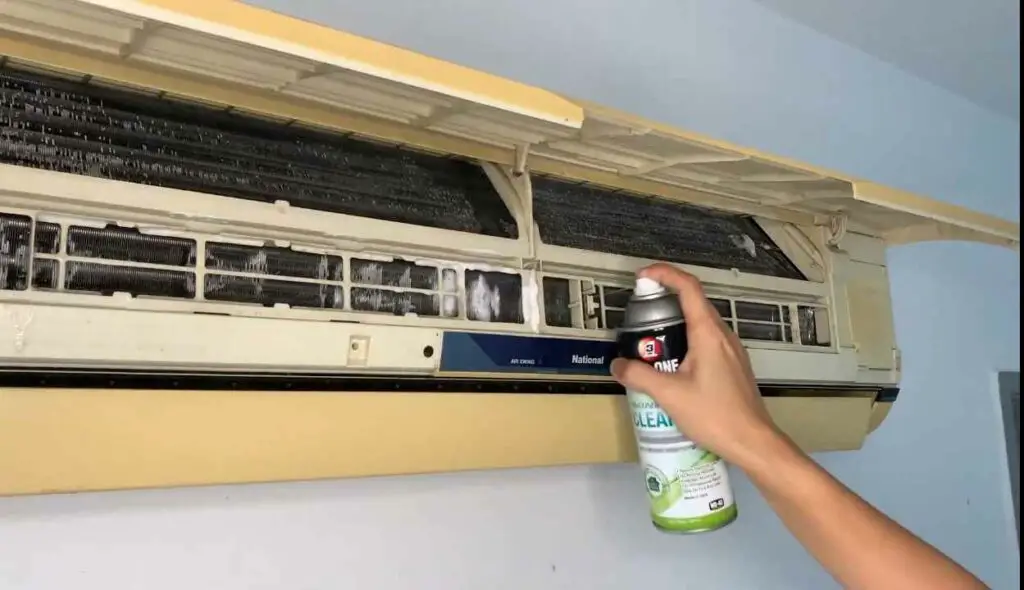
Cleaning condenser coils: Use a soft brush or fin comb designed for AC units. Never spray WD-40 on coils as it can enter the refrigerant system. For stubborn dirt, use coil cleaner specifically labeled for AC systems.

Loosening frozen bolts on the outdoor unit: A penetrating oil is appropriate here since you’re not affecting the refrigerant circuit. However, wipe excess oil away and don’t let it drip into the coils or onto electrical components.

Lubricating door hinges or other metal parts of the unit housing: Light machine oil is fine for non-critical metal parts on the exterior. Avoid the interior entirely.

Frequently Asked Questions

Can I use general-purpose oil on my AC unit? Not on any part of the refrigerant circuit. Only use specialized ester or POE oils for compressor and internal AC components. For external parts like motor shafts on older units, lightweight machine oil is acceptable in very small amounts.

What if I accidentally used WD-40 inside my AC? Contact a licensed HVAC technician immediately. They can perform a system flush and contamination test. Continuing to run the unit will spread WD-40 throughout the refrigerant lines and likely cause compressor failure.

Is WD-40 electrical contact cleaner safe for AC? No. WD-40 and all its product line variants are incompatible with AC refrigerant systems. Never use any WD-40 brand product on air conditioning units.

How often should I lubricate my AC unit? Modern sealed units don’t require homeowner lubrication at all. Professional maintenance (once per year) includes any necessary oil adjustments by a technician using the correct oils and quantities.

AC Lubrication and Maintenance

5/5 - (2 votes)
Ralph P. Sita
Author: Ralph P. Sita

Ralph P. Sita is a seasoned professional with deep roots in both the HVAC and tech industries. His family’s business, Ralph P. Sita, Inc., is a locally owned and operated HVAC contractor with over 42 years of experience, serving the DC, Maryland, and Virginia areas. The company specializes in residential, commercial, and industrial heating, ventilation, and air conditioning services, offering everything from installation and maintenance to custom ductwork and indoor air quality solutions -www.ralphpsita.com. A former CPA, he spent the last decade as co-founder and co-CEO at Cybrary, a leading platform for cybersecurity and IT training. Cybrary became the largest, most well-known cybersecurity training businesses in the industry under his leadership. Smart AC Solutions is an opportunity to give back to the HVAC community by providing reliable, actionable information on all things heating and cooling.

Related Articles:

  1. Do AC Units Pull Air from Outside? How It Works
  2. How Much Do Central Air Conditioner Units Cost? The Price Dilemma
  3. Do All AC Units Have Drip Pans? (Explained)
  4. Who Manufactures Mr Cool Ac Units
Ralph P. Sita

Ralph P. Sita is a seasoned professional with deep roots in both the HVAC and tech industries. His family’s business, Ralph P. Sita, Inc., is a locally owned and operated HVAC contractor with over 42 years of experience, serving the DC, Maryland, and Virginia areas. The company specializes in residential, commercial, and industrial heating, ventilation, and air conditioning services, offering everything from installation and maintenance to custom ductwork and indoor air quality solutions -www.ralphpsita.com.

A former CPA, he spent the last decade as co-founder and co-CEO at Cybrary, a leading platform for cybersecurity and IT training. Cybrary became the largest, most well-known cybersecurity training businesses in the industry under his leadership.

Smart AC Solutions is an opportunity to give back to the HVAC community by providing reliable, actionable information on all things heating and cooling.

Linkedin

Try our new Smart AC Solutions GPT

Description of Smart AC Solutions GPT and link to access.

  • Mastering Whole-Home Ventilation Rate Calculations: A Guide to ASHRAE 62.2 Standards
    by Ralph P. Sita
  • Understanding the Ozone-Based Air Purifier Risks in Occupied Spaces
    by Ralph P. Sita
  • Duct Pressurization Testing (Duct Blaster) Explained: What You Need to Know
    by Ralph P. Sita
  • Optimize Your HVAC Scheduler for Utility Time-of-Use Rates and Slash Energy Bills
    by Ralph P. Sita
  • Ensuring Home Energy Management System (HEMS) Compatibility for Your Smart Home
    by Ralph P. Sita
  • Fresh Air Damper Sizing Guide for Tight Construction: Ensuring Optimal Ventilation
    by Ralph P. Sita

Sites we love:
TrainACE

Facebook Twitter Pinterest YouTube

SmartACSolutions is your go-to source for the latest in heating and air conditioning news, tips, and expert advice.

  • About Us
  • Contact Us
  • Disclaimer
  • Privacy Policy
  • Sitemap

© 2026 Smart AC Solutions । DMCA Protected

SmartACSolutions.com is a property of FieldBin Inc.

Change Location
Find awesome listings near you!
  • Categories
    • AC Troubleshooting
    • Air Conditioner
      • Portable Air Conditioners
      • Room Air Conditioners
      • Split System Air Conditioners
      • Window Air Conditioners
      • Reviews & Prices
    • Thermostat Solutions
    • Calculator
  • Directory
  • Request HVAC Service
  • Join Our Pro Network
    • HVAC Businesses
      • Residential
      • Commercial
      • Emergency Services
    • Add Business
  • Register
  • Login
  • Forgot Password?