Skip to content
Smart AC Solutions
  • CategoriesExpand
    • AC Troubleshooting
    • Air ConditionerExpand
      • Portable Air Conditioners
      • Room Air Conditioners
      • Split System Air Conditioners
      • Window Air Conditioners
      • Reviews & Prices
    • Thermostat Solutions
    • Calculator
  • Directory
  • Request HVAC Service
  • Join Our Pro NetworkExpand
    • HVAC BusinessesExpand
      • Residential
      • Commercial
      • Emergency Services
    • Add Business
  • Register
  • Login
  • Forgot Password?
Smart AC Solutions
Troubleshoot

E4 Error on an Air Conditioner: Causes & How to Fix It

ByRalph P. Sita Updated onJune 28, 2026

To fix an E4 error on an air conditioner, first know that E4 is not one universal fault — its meaning changes by brand and unit type. On most window and portable units, E4 points to a temperature-sensor problem or, on some portables, a full internal water tank. On many mini-split (ductless) systems, E4 flags a communication or wiring fault between the indoor and outdoor units, or a refrigerant-temperature protection trip. The fast fixes are the same across most units: power the AC off at the outlet or breaker for two to three minutes to clear the code, then check the air filter, drain, and sensor connections. If E4 returns immediately, the sensor or control board likely needs a technician. Always confirm the meaning in your model’s manual before replacing parts.

Page Contents

Toggle
  • How to Fix an E4 Error on an Air Conditioner
  • What E4 Means by Unit Type
  • How to Reset the E4 Error Code
  • Troubleshooting E4 on the Indoor Unit of a Split AC
  • Frequently Asked Questions
    • Is E4 a serious error on an air conditioner?
    • Why does my AC keep showing E4 after I reset it?
    • Can I fix an E4 error myself?
  • Next Steps
    • Related Articles

How to Fix an E4 Error on an Air Conditioner

How to Fix an E4 Error on an Air Conditioner?
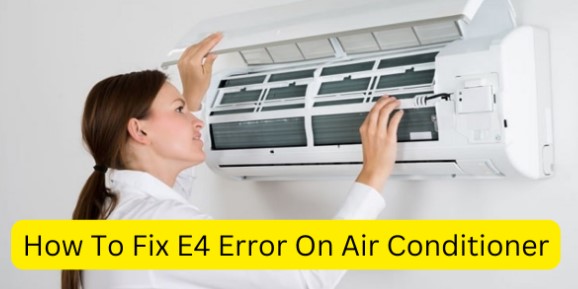
Work through these steps in order. They are safe for a DIYer and clear most E4 codes caused by airflow, drainage, or a temporary glitch. Stop and call a professional before touching refrigerant lines or opening sealed electrical components.

  1. Power-cycle the unit. Turn the AC off, unplug it (or switch off its breaker), and wait two to three minutes. Many E4 codes are a one-time protection trip that clears on restart.
  2. Check and clean the air filter. A clogged filter restricts airflow and can confuse the temperature sensors that trigger E4. Clean it or replace a damaged one. See our guide on cleaning a portable AC filter.
  3. Empty the water tank or clear the drain (portable units). On several portable models, E4 means the internal condensate tank is full. Drain it, and clear any blockage in the condensate drain line.
  4. Inspect the sensor and wiring connections. A loose or corroded temperature-sensor plug is a common E4 cause. With the power off, reseat any easily accessible sensor connectors. Do not cut or splice wiring.
  5. Look for refrigerant-leak signs. Oil stains or wet spots near the lines suggest a leak. Refrigerant is not a DIY repair — shut the unit down and book a licensed technician.
  6. Restart and watch the next cycle. Restore power and run the AC. If E4 stays clear, the issue was airflow, drainage, or a glitch. If it returns, move to a sensor or control-board diagnosis.

What E4 Means by Unit Type

Because manufacturers assign E4 to different faults, the right fix depends on what kind of AC you own. Match your unit to the list below, then confirm in the manual.

What Does E4 Mean on a Thermostat?
  • Portable AC: Most often a full internal water tank or a temperature-sensor fault. Drain the tank first; if E4 persists, suspect the sensor.
  • Window AC: Usually a temperature- or coil-sensor reading out of range, sometimes tied to restricted airflow or a dirty filter.
  • Mini-split / ductless: Commonly a communication error between the indoor and outdoor units, faulty indoor PCB, or a refrigerant-temperature protection trip. Check that indoor-to-outdoor wiring is secure.
  • Some brands: A handful of units use E4 to indicate the room is too cold and the unit has entered a protective stop in heat or defrost mode. In that case the code clears once conditions normalize.

How to Reset the E4 Error Code

A reset clears any E4 that was a temporary protection trip rather than a hard fault:

  1. Turn the air conditioner off using the remote or panel.
  2. Unplug the unit, or switch off its circuit breaker, and wait two to three minutes so the control board fully powers down.
  3. Restore power and turn the unit back on. The display should clear.
  4. If your model has a dedicated reset button (often behind the panel or on the side), press and hold it for about five seconds, then release.
  5. Run a full cooling cycle and watch whether E4 returns. A code that comes straight back points to a real sensor, wiring, or board issue, not a glitch.

Troubleshooting E4 on the Indoor Unit of a Split AC

On a split system, E4 frequently traces back to the indoor unit and its link to the outdoor condenser. Work through these checks:

  1. Confirm a steady power supply. Voltage drops and brownouts can trip protective codes. Make sure the indoor unit is getting stable power.
  2. Check the indoor-to-outdoor wiring. Loose or damaged communication wires between the two units are a leading E4 cause on mini-splits. With power off, verify connections are tight and undamaged; leave terminal repairs to a technician.
  3. Clean the air filters. Dirty filters choke airflow and skew sensor readings. Clean or replace them per the manufacturer’s schedule.
  4. Clear the condensate drain. A blocked drain can back up water and trigger faults; flush any clog.
  5. Inspect the temperature sensors. A failed or out-of-spec sensor commonly causes E4. Reseat the sensor connector; replacement should be done by a technician with the correct part.
  6. Reset the system. Power down for a few minutes per the manual to clear temporary faults.
  7. Call a professional if E4 persists. A recurring code after these steps usually means a sensor, PCB, or refrigerant-side problem that needs proper diagnostic tools.

Frequently Asked Questions

Is E4 a serious error on an air conditioner?

Not always. On portable units it often just means the water tank is full, and on some systems it is a protective stop that clears on its own. It becomes serious only when it points to a failed sensor, wiring fault, control board, or refrigerant issue and keeps returning after a reset.

Why does my AC keep showing E4 after I reset it?

A code that returns immediately means the underlying fault is still present — most often a defective temperature sensor, a loose or corroded connector, or on a split system a communication problem between the indoor and outdoor units. At that point, have a technician diagnose it.

Can I fix an E4 error myself?

You can safely handle the common causes: power-cycling, cleaning the filter, draining the tank, clearing the condensate drain, and reseating accessible sensor connectors. Leave refrigerant work, control-board replacement, and internal wiring repairs to a licensed HVAC professional.

Next Steps

Start with the simple, safe checks — power-cycle, filter, drain, and sensor connections — and confirm your unit’s exact E4 meaning in the manual. If the code clears, you are done. If it returns right away, that is your signal to bring in a professional rather than guessing at parts, especially on split systems where E4 can involve refrigerant or control-board faults.

5/5 - (2 votes)
Ralph P. Sita
Author: Ralph P. Sita

Ralph P. Sita is a seasoned professional with deep roots in both the HVAC and tech industries. His family’s business, Ralph P. Sita, Inc., is a locally owned and operated HVAC contractor with over 42 years of experience, serving the DC, Maryland, and Virginia areas. The company specializes in residential, commercial, and industrial heating, ventilation, and air conditioning services, offering everything from installation and maintenance to custom ductwork and indoor air quality solutions -www.ralphpsita.com. A former CPA, he spent the last decade as co-founder and co-CEO at Cybrary, a leading platform for cybersecurity and IT training. Cybrary became the largest, most well-known cybersecurity training businesses in the industry under his leadership. Smart AC Solutions is an opportunity to give back to the HVAC community by providing reliable, actionable information on all things heating and cooling.

Related Articles:

  1. Fujitsu Inverter R410A Error Code | Common Causes and Solutions
  2. Daikin Error Code U4: Meaning, Causes, and Solutions
  3. How to Fix E1 Error on Air Conditioner
  4. How to Fix P1 Error on Air Conditioner Midea
Ralph P. Sita

Ralph P. Sita is a seasoned professional with deep roots in both the HVAC and tech industries. His family’s business, Ralph P. Sita, Inc., is a locally owned and operated HVAC contractor with over 42 years of experience, serving the DC, Maryland, and Virginia areas. The company specializes in residential, commercial, and industrial heating, ventilation, and air conditioning services, offering everything from installation and maintenance to custom ductwork and indoor air quality solutions -www.ralphpsita.com.

A former CPA, he spent the last decade as co-founder and co-CEO at Cybrary, a leading platform for cybersecurity and IT training. Cybrary became the largest, most well-known cybersecurity training businesses in the industry under his leadership.

Smart AC Solutions is an opportunity to give back to the HVAC community by providing reliable, actionable information on all things heating and cooling.

Linkedin

Try our new Smart AC Solutions GPT

Description of Smart AC Solutions GPT and link to access.

  • Mastering Whole-Home Ventilation Rate Calculations: A Guide to ASHRAE 62.2 Standards
    by Ralph P. Sita
  • Understanding the Ozone-Based Air Purifier Risks in Occupied Spaces
    by Ralph P. Sita
  • Duct Pressurization Testing (Duct Blaster) Explained: What You Need to Know
    by Ralph P. Sita
  • Optimize Your HVAC Scheduler for Utility Time-of-Use Rates and Slash Energy Bills
    by Ralph P. Sita
  • Ensuring Home Energy Management System (HEMS) Compatibility for Your Smart Home
    by Ralph P. Sita
  • Fresh Air Damper Sizing Guide for Tight Construction: Ensuring Optimal Ventilation
    by Ralph P. Sita

Sites we love:
TrainACE

Facebook Twitter Pinterest YouTube

SmartACSolutions is your go-to source for the latest in heating and air conditioning news, tips, and expert advice.

  • About Us
  • Contact Us
  • Disclaimer
  • Privacy Policy
  • Sitemap

© 2026 Smart AC Solutions । DMCA Protected

SmartACSolutions.com is a property of FieldBin Inc.

Change Location
Find awesome listings near you!
  • Categories
    • AC Troubleshooting
    • Air Conditioner
      • Portable Air Conditioners
      • Room Air Conditioners
      • Split System Air Conditioners
      • Window Air Conditioners
      • Reviews & Prices
    • Thermostat Solutions
    • Calculator
  • Directory
  • Request HVAC Service
  • Join Our Pro Network
    • HVAC Businesses
      • Residential
      • Commercial
      • Emergency Services
    • Add Business
  • Register
  • Login
  • Forgot Password?