Skip to content
Smart AC Solutions
  • CategoriesExpand
    • AC Troubleshooting
    • Air ConditionerExpand
      • Portable Air Conditioners
      • Room Air Conditioners
      • Split System Air Conditioners
      • Window Air Conditioners
      • Reviews & Prices
    • Thermostat Solutions
    • Calculator
  • Directory
  • Request HVAC Service
  • Join Our Pro NetworkExpand
    • HVAC BusinessesExpand
      • Residential
      • Commercial
      • Emergency Services
    • Add Business
  • Register
  • Login
  • Forgot Password?
Smart AC Solutions
Air Conditioner

E5 Error Code on AC: What It Means by Brand & Type

ByRalph P. Sita Updated onJune 28, 2026

E5 on your air conditioner is an error code, and what it means depends on the type and brand of unit. On most portable and window ACs, E5 usually points to a full water collection tank or a drainage problem. On split and central systems, E5 most often flags an evaporator temperature-sensor fault, though some brands use it for low refrigerant, a communication fault, or a voltage problem at the outdoor unit. Below we break down what E5 means on a portable AC versus a split system, then cover the code brand by brand for Carrier, Hisense, LG, Gree, and Daikin so you can match it to the unit in front of you. Always confirm against your model’s manual, because the same two characters can mean different things on different equipment.

Page Contents

Toggle
  • What Does E5 Mean on My Air Conditioner?
  • How Do I Fix Error E5 on My Air Conditioner?
  • E5 Error Code on a Carrier Air Conditioner
  • Hisense Air Conditioner Error Code E5
  • E5 Error Code on an LG Air Conditioner
  • E5 Error Code on a Gree Air Conditioner
  • E5 Error Code on a Daikin Air Conditioner
  • Frequently Asked Questions
    • Does E5 mean the same thing on every air conditioner?
    • Can I fix an E5 error myself?
    • Will E5 clear on its own?
  • Next Steps
    • Related Articles

What Does E5 Mean on My Air Conditioner?

There is no single universal meaning for E5, so start by identifying your unit type:

  • Portable AC: E5 most commonly means the internal condensate tank is full. Many portable units have a sensor that trips this code when water needs to be emptied, or when a float switch is stuck.
  • Window/mini-split: E5 usually signals a problem with the evaporator (indoor coil) temperature sensor reading out of range, a communication issue, or in some brands a refrigerant or voltage fault.
  • Drainage-related E5: On units that report E5 for drainage, the likely causes are a blocked condensate drain line, a full drain pan, a failed condensate pump, or a faulty drain switch.

Because the meaning varies, the safest first move is to check your owner’s manual or the brand’s support page for your exact model number before ordering parts.

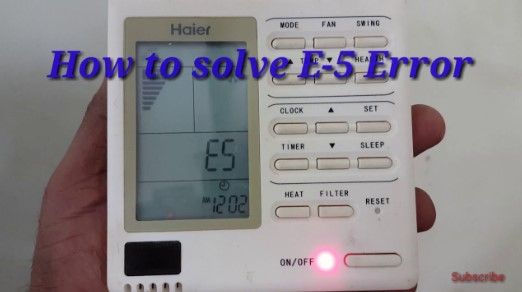
What does E5 mean on my Air Conditioner?

How Do I Fix Error E5 on My Air Conditioner?

Work through these steps in order. They cover the most common E5 triggers and are safe for a homeowner to attempt before calling a technician.

  1. Power-cycle the unit. Turn the AC off, unplug it (or switch off the breaker) for two to three minutes, then restart. A transient sensor glitch will often clear with a reset.
  2. Empty the water tank or drain pan. On portable units, locate the drain plug and empty the collection tank fully. On window and split units, check that the drain pan is not overflowing.
  3. Clear the condensate drain. A blocked drain line is a frequent cause. Check the line for clogs and clear it if you are comfortable doing so.
  4. Inspect the float switch and pump. A stuck float switch or a failed condensate pump can hold the code on. Reseat the float; replace the pump if it is not running.
  5. Check the evaporator sensor. If your unit ties E5 to the coil sensor, make sure the sensor connector is seated and the sensor is clean.
How do I fix error E5 on my air conditioner?

If E5 returns after a reset and a drain check, the fault is likely a failed sensor, a refrigerant problem, or a control-board issue. Those calls for a licensed HVAC technician, especially anything involving refrigerant or wiring inside the unit.

E5 Error Code on a Carrier Air Conditioner

On Carrier units, E5 typically indicates a problem with the evaporator (indoor coil) temperature sensor, such as the sensor reading out of range, drifting out of calibration, or losing connection. Check that the sensor connector is seated and the sensor is clean. If the code persists after a reset, have a technician test and replace the sensor. Left unaddressed, a bad temperature reading can cause short cycling or a protective shutdown.

Hisense Air Conditioner Error Code E5
Hisense Air Conditioner Error Code E5

Hisense E5 depends on the model. On Hisense portable air conditioners, E5 most often means the internal water tank is full and needs draining, after which the code clears once the unit restarts. On other Hisense models, E5 signals an abnormal temperature-sensor reading; the fix is to clean the temperature sensors on the indoor and outdoor units and check their connections. If draining and cleaning do not clear it, or you suspect a refrigerant issue, contact a professional rather than opening the sealed system.

E5 Error Code on an LG Air Conditioner

On LG units, E5 often points to a communication or sensor issue between the unit and the indoor evaporator coil, commonly a faulty sensor or compromised wiring. Try this:

  1. Reset the unit: switch it off and back on. A reset can clear a temporary communication error.
  2. Check the sensor: inspect the indoor coil sensor and gently clean it with a soft cloth if it is dirty.
  3. Check the wiring: confirm connections between the sensor and the unit are firm and undamaged.

If E5 continues, it may indicate a deeper fault in the unit and warrants professional attention. Always refer to LG’s guidelines for your specific model.

E5 Error Code on a Gree Air Conditioner

On Gree units, E5 generally indicates an evaporator temperature-sensor issue (and on some inverter models, an overcurrent or low-voltage protection). Troubleshoot in this order:

  1. Check connections: make sure the sensor is securely connected.
  2. Inspect for debris: look for dirt or buildup that could affect the sensor.
  3. Replace if needed: if the code persists, the sensor may need replacing by a technician.

E5 Error Code on a Daikin Air Conditioner

On Daikin systems, E5 commonly relates to the outdoor unit not receiving the appropriate voltage (on some models it indicates compressor motor overload protection). Likely causes include a tripped circuit breaker, a power-supply problem, or a fault in the outdoor unit.

  1. Check the power supply: confirm the outdoor unit is getting proper voltage and the breaker has not tripped.
  2. If it persists: a voltage or compressor-protection fault should be diagnosed by a professional technician promptly.

Frequently Asked Questions

Does E5 mean the same thing on every air conditioner?

No. E5 is a manufacturer-defined code, not an industry standard. On portable units it usually means a full water tank; on split systems it often means a sensor, refrigerant, communication, or voltage fault. Always check your model’s manual.

Can I fix an E5 error myself?

Often yes for the simple causes: resetting the unit, emptying the water tank, and clearing a clogged drain are all homeowner-safe. Sensor replacement, refrigerant work, and electrical faults should go to a licensed technician.

Will E5 clear on its own?

If the trigger was a full tank or a momentary glitch, the code usually clears once you empty the water and power-cycle the unit. If it returns immediately, there is an underlying fault to fix.

Next Steps

Identify your unit type first, then match E5 to your brand. Start with the free, safe fixes: reset the unit, empty the water tank, and clear the drain. If the code returns and points to a sensor, refrigerant, or electrical fault, bring in a licensed HVAC technician and keep your model number handy so the diagnosis is accurate.

4.4/5 - (5 votes)
Ralph P. Sita
Author: Ralph P. Sita

Ralph P. Sita is a seasoned professional with deep roots in both the HVAC and tech industries. His family’s business, Ralph P. Sita, Inc., is a locally owned and operated HVAC contractor with over 42 years of experience, serving the DC, Maryland, and Virginia areas. The company specializes in residential, commercial, and industrial heating, ventilation, and air conditioning services, offering everything from installation and maintenance to custom ductwork and indoor air quality solutions -www.ralphpsita.com. A former CPA, he spent the last decade as co-founder and co-CEO at Cybrary, a leading platform for cybersecurity and IT training. Cybrary became the largest, most well-known cybersecurity training businesses in the industry under his leadership. Smart AC Solutions is an opportunity to give back to the HVAC community by providing reliable, actionable information on all things heating and cooling.

Related Articles:

  1. Hisense Air Conditioner E9 Error Code: What It Means and How to Fix It
  2. Toshiba Portable AC AP Code: What It Means & How to Fix
  3. Why Does My AC Say Wait? What It Means & How to Fix It
  4. 5 Common Signs of Split Type AC Compressor Failure
Ralph P. Sita

Ralph P. Sita is a seasoned professional with deep roots in both the HVAC and tech industries. His family’s business, Ralph P. Sita, Inc., is a locally owned and operated HVAC contractor with over 42 years of experience, serving the DC, Maryland, and Virginia areas. The company specializes in residential, commercial, and industrial heating, ventilation, and air conditioning services, offering everything from installation and maintenance to custom ductwork and indoor air quality solutions -www.ralphpsita.com.

A former CPA, he spent the last decade as co-founder and co-CEO at Cybrary, a leading platform for cybersecurity and IT training. Cybrary became the largest, most well-known cybersecurity training businesses in the industry under his leadership.

Smart AC Solutions is an opportunity to give back to the HVAC community by providing reliable, actionable information on all things heating and cooling.

Linkedin

Try our new Smart AC Solutions GPT

Description of Smart AC Solutions GPT and link to access.

  • Mastering Whole-Home Ventilation Rate Calculations: A Guide to ASHRAE 62.2 Standards
    by Ralph P. Sita
  • Understanding the Ozone-Based Air Purifier Risks in Occupied Spaces
    by Ralph P. Sita
  • Duct Pressurization Testing (Duct Blaster) Explained: What You Need to Know
    by Ralph P. Sita
  • Optimize Your HVAC Scheduler for Utility Time-of-Use Rates and Slash Energy Bills
    by Ralph P. Sita
  • Ensuring Home Energy Management System (HEMS) Compatibility for Your Smart Home
    by Ralph P. Sita
  • Fresh Air Damper Sizing Guide for Tight Construction: Ensuring Optimal Ventilation
    by Ralph P. Sita

Sites we love:
TrainACE

Facebook Twitter Pinterest YouTube

SmartACSolutions is your go-to source for the latest in heating and air conditioning news, tips, and expert advice.

  • About Us
  • Contact Us
  • Disclaimer
  • Privacy Policy
  • Sitemap

© 2026 Smart AC Solutions । DMCA Protected

SmartACSolutions.com is a property of FieldBin Inc.

Change Location
Find awesome listings near you!
  • Categories
    • AC Troubleshooting
    • Air Conditioner
      • Portable Air Conditioners
      • Room Air Conditioners
      • Split System Air Conditioners
      • Window Air Conditioners
      • Reviews & Prices
    • Thermostat Solutions
    • Calculator
  • Directory
  • Request HVAC Service
  • Join Our Pro Network
    • HVAC Businesses
      • Residential
      • Commercial
      • Emergency Services
    • Add Business
  • Register
  • Login
  • Forgot Password?